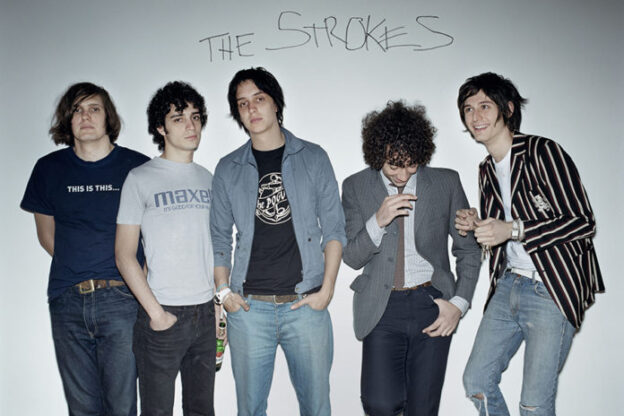
The Strokes – Is This It (Album Review)

The colliding lifestyle of fortune, sex, dating, drinking, and the uncertainty of it all as it rests on fleeting youth in New York City; those moments are on full display in the studio debut album Is This It by American rock band The Strokes. Released in the US on October 9th 2001, the album builds on their EP The Modern Age which resulted in a record studio bidding war over the band’s Garage/Indie rock sound that would soon be considered one the best rock albums of the 21st century.

The band’s members Julian Casablancas(Vocals), Albert Hammond Jr(lead guitarist), Nick Valensi(guitarist), Nikolai Fraiture(Bassist), and Fabrizio Moretti(drums) start off with the song “Is This It” which ironically sounds like the end of a long night of partying. The consistent tired heartbeat of the bass and drum with a guitar melody that sounds like it’s trying to pick up but never does, reflects the lyrics “Can’t you see I’m trying?/ I don’t even like it/ I just lied to/ Get to your apartment” a guy not sure whether to continue the night or to just rest for the next one that comes along. Other songs on the album like “The Modern Age”, “When It Started”, and “Someday” (Darling, your head’s not right/ Ah, see, alone we stand, together we fall apart/ Yeah, I think I’ll be alright) also share the somber tone that dating life delivers, either acknowledging time by the nights spent or of the years that could quickly pass. 

That isn’t to say that the album doesn’t have the hard thrashing rock and dry vocals of wet passion, if anything the album manages to transition up to the sounds between tracks and within songs. “Alone, Together”, “Take It Or Leave It”, and “Trying Your Luck” are amplified by Valensi’s sharp guitar riffs that manage to not poke through, but rest on Fraiture’s bass and Moretti’s pulsating backbeat drums that try to contain the rhythm. Then there’s Hammond Jr.’s guitar solos where the sped-up distortion sounds like cool metal grinding on each other like the cat and mouse game guys and girls play. Or as Ann Powers in Good Booty would describe that space rock spoke to, “[b]oys were encouraged to channel their sexual urges into constructive activities,[…] girls had to be both alluring and modest, encouraging boys while discouraging them.” The solos were encircled by Casablancas’s lyrics of that space, “He knows it’s justified to kill to survive/[…]The world is over and I don’t care[…]” The lyrics are so relatable that it makes you want to say them to the girls you had before or hoped that guy you let in your life could have been as honest.

Then there’s the tracks that land in the middle “Last Nite”, “Hard To Explain”, “Barely Legal” which made the band all the more special. The guitar, bass, and drums in these songs are sort of huddled together like controlled adrenaline, like waiting in the lobby of the apartment before she lets you in. A chorus like “I just want to misbehave/ I just want to be your slave/ Oh, you ain’t never had nothing I wanted, but/ I want it all[…]” said what many felt but were too into themselves to say it. That being sympathetic or vulnerable was not the result of that ‘one girl that one night’ or an exception of the rule when you’re a player or what makes you different from all the other guys; it’s a packaged deal. You’re going get your heart hurt but you’re gonna have fun while doing it. 

Those studios knew the band’s sound would entice a generation of kids who wanted to be the overthinking aloof guys who could get any girl they wanted while lamenting on how hard it is to be a person who doesn’t care.

MNDSGN- Rare Pleasure review

https://youtu.be/AyQNZ1igBoY

If one is unfamiliar with MNDSGN (sounded Mind Design) they probably enjoy the nescient underpinning of that boulder they happen to call “home.”. While that may have come across as pompous and or representative of the sort gatekeeping attitude other music reviewers and certain fans seem to carriage, I meant that in the “I can’t wait to show you more!”…. Sort of way. Anyways this Los Angels based, Jersey-born producer is no stranger to cheffing together beats incorporating flavors of ’80s funk, classic soul, jazz, and samba as he effortlessly tops off the most intimate elements of these genres to express joyful and vibrant musical synergy. And his influences seem to stem more from interpersonal experiences than anything else—from being raised on gospel music at church, to coming from a culture of b-boying at home, to forming the Klipmode collective with fellow beatmakers such as Knxwledge, before relocating to sunny Los Angeles in 2011.

    Rare Pleasure is Mndsgn’s second proper album (in between the mix of collaborations and mixtapes) since 2016’s Body Wash, which highlighted the producer’s ability to pull at the strings of nostalgia by weaving together ’70s synths and funk sounds. In the song “Hope You’re Doin’ Better,” Mndsgn dreamily follows the title’s wish with the sincere promise in the 1st verse, “You’re not alone / You know you got a friend whenever you need one / Pick up your phone.” Also the woozy neo-ballad titled ‘Masque’, compliments “Hope your doing better” so smoothly it allows one to recall a sort of familiar Frank Ocean, but at his haziest. Elsewhere, ‘Medium Rare’ might be the standout, cut from similar cloth to ‘Masque’ but imbuing the blueprint with jazzy flourishes of piano and saxophone, while holding onto the artistic integrity of  late 70s and 80s sonics.

    Mndsgn began exploring these themes  on his Stones Throw debut Yawn Zen (2014), which he followed up with Body Wash (2016). Raw, mixtape-style records Snax and Snaxx followed in 2018 and 2019. Rare Pleasure’s personal and musical forces bring depth and texture to the album’s tracks. Together, they establish a soundtrack to scenes of vulnerability (romantic intimacy in “Slowdance;” fear in “Colours of the Sunset;” self-care in “Medium Rare)  confided by Mndsgn to the listener through his sensitive instrumental ear and cinematic storytelling approach. Sensitive themes are paired  with recurring musical motifs that echo throughout the record, drawing from library music, and soundtrack music. Whether it is the 1970s Quincy Jones-tinged “Rare Pleasure II,” thicc bump-and-roll of “Rare Pleasure III,” or the bossa nova hustle of “Rare Pleasure IV,” these are storytelling  moments executed to the fullest without the use of language.

    By caring for a loved one’s mental health as well as his own, Mndsgn has transformed his skills as a beatmaker producer into something far more exceptional while bestowing his first slow-burner album of his catalog.


Katherine Sanchez: Performance Review, Mochilla Presents Timeless: Suite for Ma Dukes

What happens when you put some of the most influential names in orchestra, hip-hop, bossa nova, and hybrid jazz from across the world in one room? Truth happens. Truth happened then, on February 22, 2009.

In 2009, Brian Cross (aka B+) organized a series of live events at the Luckman Fine Arts Complex in Los Angeles. The Timeless series captured the lasting impact of several artists on the world of hip-hop and beyond. Live, fully orchestrated performances by Ethiopia’s Mulatu Astatke and Brazil’s Arthur Verocai bookended the Suite For Ma Dukes, a tribute to James “J Dilla” Yancey, by Miguel Atwood-Ferguson. The tribute began with a few words from the artists present:

“How’s everybody feeling’? I just wanna say I feel blessed to be here, to hear JD’s music being expressed in this way is just another step towards how great his music, how wonderful and how divine it is. There’s not many times I created music that I felt like it was the most divine music and being able to do that with J Dilla it was some typa connection that I couldn’t describe to anybody.”

Wonderful, divine, great: Common couldn’t have put it any better. I mean, from his unique vantage point as a revered legend in rap and frequent collaborator with late producer James Yancey, better known by his future moniker J Dilla, his word is essentially truth. Which is a word that comes as close as I can think to describing the essence of that room where the Timeless series blossomed for the celebration of sound and as tribute to Dilla: truth.

On Mochilla Presents Timeless: Suite for Ma Dukes Miguel Atwood-Ferguson pays tribute to Dilla by interpreting his music for a 60-piece orchestra featuring special guests Bilal, Dwele, Posdnuos, Thundercat, Talib Kweli, Karriem Riggins and more. This coming together of artists was nothing short of magic set to music. This premiere performance left many in the sold out crowd in tears, with famed BBC personality Giles Petersen saying “That’s just about the most powerful thing I’ve heard. Brilliant.”

Any lover of hip-hop could talk your ear off about the impact J Dilla’s production made on everyone in the scene. Full-length books have been written about him, his style, how he pushed music forward and played with composition and form in new and inspiring ways. Inspiring to many, including Questlove and Erykah Badu. Take it from Kanye West himself, producer of producers:

“Me and Common would go play basketball and hang and all that. But me and Dilla just focused on tracks. He had the organic feel but still the sonics were breakthrough, and he could give you a warm sound that still cut through speakers. It’s like he was making Quincy Jones production sessions inside his MPC.”

JD’s influence is astounding given the brevity of his time on earth: he passed away at 32 due to lupus. Just 32, and his legacy inspires musicians from around the world, from across genres, to get up and come together and dance and sing and even cry. That’s all another way of saying “to heal.”

That’s what I felt, at least, when I first came across the DVD recording of this performance on YouTube so many years ago. I have been a fan of Dilla for a long time, namely of his hallmark album “Donuts,” without really understanding the impact of his work. I simply felt the music. It spoke to something in me which wanted healing. Take this song, for example, the Timeless performance of “Fall in Love,” a song produced for Slum Village.

Hearing the iconic melody set to an orchestra for the first time was like falling in love. The symbols crashing, the bells reverberating in the first minute. Then the horns like slow and serene rivers, with high woodwinds prancing over the drumbeat, held tight by Riggins. The build-up burning, then letting up into the sliding violins which seem to close out the song, but then come in deep horns and shimmering synths and everything comes together. And then, of course, the cheering crowd, their clapping throughout like a pacemaker. In the recording, a camera pans over to a seat left open with a cello leaning against it as the music swells—Dilla’s instrument. That is where he would have sat.

This rendition is not unlike the original sonically. Its musical essence remains intact and in many ways is both heightened and deepened with the love of collaboration. They find new valleys and caverns in the track to explore and build upon. Every member of the room, from the audience to the backup singers to JD’s mom herself, Ma Dukes, is involved and enthralled and in love.

Brilliant, truth, love: take from this review what you will, but from the recordings of that event? You would have a hard time denying these elements from making an impression on you. Take a listen, you might fall in love.

Monica Sarduy: Album Review_Assignment 1: Channel Orange


Recklessly driving with your friends because there seems to be no consequences for the young and lavish. Casual sex, religion, and drug cooking girlfriends. Unrequited love, pleasure, and universal meaning. This is, Channel Orange. Frank Ocean dives deep into themes of unrequited love and privilege in Los Angeles through his groundbreaking album, Channel Orange. His genius is the reason why I am writing about an album that came out 10 years ago. Frank, we miss you. Stopping myself from revisiting this album every day is almost impossible as Ocean’s poetry fills my car, my room, leaving me cathartic EVERY DAMN TIME. 

“Bad Religion” is one of those songs that is a whole experience in itself. With Ocean’s steady rhythmic chord structure  placing you in a cathedral right from the start, it begins the experience of placing you in that religious setting. This story takes place in a taxi cab where Frank is drinking himself deeper and deeper into despair while using the taxi cab driver as his personal therapist. He compares unrequited love to “ a one-man cult”, or is he talking about religion? That’s just the beauty of his work, it somehow leaves the listener guessing and understanding all at the same time. At 1:30 the listener is introduced to inconsistent claps. The offbeat syncopation shows that Ocean is relating to how something is not adding up in his life. As we get further and further into his mind the music becomes more grandiose following more consistent claps that fit the natural accents in the chord that we were hoping to find as some sort of closure. His cry that he lets out in the chorus, “If it brings me to my knees” brings the listener closer to him. It is as if he is asking us to really listen to him, to really pay attention to his words, to his cries. 

“Pink Matter”, with the help of André 3000 is just another one of those songs that leaves you in an otherworldly futuristic “wtf was that” kind of state. The slow funky guitar riff consistently playing throughout the piece creates a groovy familiarity while listening to lyrics like “Sensei replied, “What is your woman? Is she just a container for the child?” That soft pink matter.” Ocean seems to be introducing new futuristic ideas through pleasure and the power of women. Following,  “What if the sky and the stars are for show And the aliens are watching live From the purple matter?” leaves the listener working hard to figure about what Frank is really trying to say. His worship for women’s ethereal qualities is displayed throughout the song especially in Ocean’s use of melisma while he cries out, “Pleasure.” He seems to idolize the female form in this ode to women. 

“Lost” has to be one of the most unconventional love stories introduced to us by Ocean. Its bright cadence throws off the listener to the meaning of his words. Ultimately this song introduces a scenario where Frank is a drug dealer who travels across borders, and even across seas while his girlfriend is cooking the drugs for him to sell. Ocean is scared that this game will ultimately leave his girlfriend lost, and him alone. Interestingly, Ocean chose to use a melody that doesn’t leave the listener in tears from this modern love story but in a groovy state where you just can’t help but sway from side to side. The chorus, “Now you’re lost, lost in the heat of it all” is backed up by an allegro series of notes. Again his constant use of melisma through the word “lost” is used for emphasis on his journey through this turbulent relationship.

Oh Frank, what goes on in that beautiful mind?


Sadia Joya: Album Review_Assignment 1: Talking is Hard by Walk the Moon

What is one song that you can immediately think about playing at a party? Well, to answer that, the first thing that comes to my mind is Shut Up and Dance by the American rock band Walk the Moon. Shut Up and Dance is just one of the twelve songs of Walk the Moon’s third studio album Talking is Hard; the song also happens to be a single. Walk the Moon debuted in 2010 with their first album I Want! but it seems to me that they hit the spotlight further with Shut Up and Dance in 2014.


If you have previously heard this song, then I can undoubtedly say that its jingle has played in your mind at least for once, whether or not you liked this song. There is guitar, banjo, piano and what not playing in the background music to create its peppy beat. The song itself is very joyful and the story that led to its creation is fascinating indeed. Once at a party, a girl asked vocalist Nicholas Petricca to dance. Petricca was reluctant to jump into the moment until the girl said, “Shut Up and Dance.” Likewise, the whole idea of this song is to come out of one’s cocoon of comfort and indulge in the present. The music video also features Petricca at a party who becomes the center of attention with his somewhat awkward dance moves. At the same time, this song connects with the listener effectively using imperatives in its chorus lyrics such as “Don’t you dare look back,” “Just keep your eyes on me,” and ultimately, makes the listener tap their toes and shake the dance floor.

Other songs in this album deliver the same pop-rock vibe, which is a signature step of Walk the Moon. Work this Body is another song in this album that again creates a successful relationship between the song and the listener. This song uses personal pronouns in its chorus lyrics such as “I will work this body,” “I swear,” “I will beat you fair and square,” in order to personalize the song along with the technique of storytelling from a third person point of view. It also has a drop at 2:09 where the melody slows down and rises again at 2:20. What amazes me about this song is that it is not the usual kind of song that only motivates you but it also creates a long lasting effect of joy that you will receive at an accomplishment of yours.

Compared to these two songs, I found Different Colors of the same album somewhat less energetic; however, this song is very important in the present day. This song asks listeners to accept every human in a positive way because ultimately it is only the skin color that distinguishes us. The chorus lyrics are captivating and use both techniques of imperatives like “Sing!” and inclusive pronouns like “we” in  “We carry each other,” “We’re just different colors.” To clear this further, Walk the Moon created the official video with clips of the diverse people they encountered during their trips.

Even if you are not a pop-rock person, Walk the Moon will surely grab your attention in a very short time. So, prepare to roll to their vibes starting with Talking is Hard!

Review Workshop Guidelines: Reviews

Each of you will receive feedback from the whole class during workshops of your reviews. Workshopping your writing can be nerve-wracking, but this is a supportive environment. We’re here to help you make the most of your writing.

As you read  drafts of your classmates’ reviews, ask yourself the following questions:

  1. What is the focus or controlling concept of the review? Is the focus clear?
  2. Does the review encompass a sufficient number of the elements common to reviews we’ve been discussing?
  3. Does the writer use music terms in a way that feels organic and enhances the review?
  4. Where is the language most interesting?
  5. Where does the language need work?
  6. What are the strongest features of the draft?
  7. What would you suggest the writer work on if they revise?

Make notes on the drafts and come to class prepared to discuss your answers to the questions below.

Record Club: Tyler The Creator ‘Find Your Wings’ (Ft. Roy Ayers, Syd Bennett, Kali Uchis)


“Find Your Wings” is a very successful evocation of the silky smooth Roy Ayers 1970s style and the whole school of positive, uplifting ’70s Black music as a whole.

Tyler the Creator has emerged as one of the foremost independent Alt-Hip Hop music maestros of today. He’s showcased this with a diverse, comical, cartoonish style  taking full advantage of social media in building his brand and audience. In his approach one can identify 21st Century George Clinton aspects, and his collective has already helped bring major artists like The Internet Band and Frank Ocean(as mentioned in class) to the forefront.  With this song in particular it fits Ann Power’s arugment of “genre mixing” in which Tyler bridges together jazz, soul, and small amounts of gospel to create this hit.

This song was released in 2015 of his 3rd studio album Cherry Bomb. This song was chosen for his beloved use of warm, airy, sometimes delicate chord progressions that are reminiscent as mentioned of the early SoulTrain era- 70s black compositions.  in this instance complement the sort of facile syncopation of the drums. Kali Uchi’s harmony with Tyler in the iconic chorus–“fiiind your wiiinnnngs” ”–adds to the hypnotic and soothing Rhodes piano Tyler is  playing along with Roy Ayers’ xylophone fills in between the grooving synth in the backbeat.

Over the years, his style of production has progressed from gritty and dark in early projects such as Goblin, but soon transitioned to a more jazz-based approach, with the album Cherry Bomb, which Okonma described in 2018 as his favorite album.

Definitions:

A harmony is when multiple tones from multiple sources come together simultaneously, in a pleasing way. When you play all the notes of a chord, you’re creating a type of harmony. The strumming of notes on a guitar can create a harmony; an orchestra of instruments playing together creates a harmony; and two or more voices singing together can create a harmony.

In a musical composition, a chord progression or harmonic progression (informally chord changes, used as a plural) is a succession of chords. Chord progressions are the foundation of harmony in Western musical tradition from the common practice era of Classical music to the 21st century. Chord progressions are the foundation of Western popular music styles (e.g., pop music, rock music), traditional music, as well as genres such as blues and jazz. In these genres, chord progressions are the defining feature on which melody and rhythm are built.

Syncopation: A disturbance or interruption of the regular flow of downbeat rhythm with emphasis on the subdivision or off-beat.

Chorus:  The chorus is intended to be the most memorable part of the song. It is repeated several times so that it sticks in your mind. Several other tricks are used to help it stick.Commonly a chorus:Contrasts with the verse, rhythmically, melodically, lyrically, harmonically and / or dynamically.A chorus is repeated at least once, both musically and lyrically. Usually several times.It is more intense, has more energy. A chorus usually has a greater musical and emotional intensity than the verse.

Find Your Wings (Just song)

Find Your Wings (Music Video) ITS FUNNY


Utopia Parkway

Queens College’s literary journal Utopia Parkway Journal is open for submissions! If you’d like to submit poetry, fiction, essays, plays, and/or visual art, you can send them to [email protected]. And get in touch if you’re interested in getting involved joining the editing staff this year! Stay tuned for announcements about this semester’s events.

You could submit anything you write for our course.
